The road from Roncevalles was lovely, and we met a bunch of folks who made the trail lighter. Stacy hooked up with a trio of ladies from Colombia and I found some folks from England who were taking pictures of the same stuff I was. And step by step, as the mountains became hills we watched France become . . . well, not Spain, but Basque.
The Basque present a problem for me as I am a former Professional Smart Ass and they are unusual. The unusual are cat toys for the Smart Asses of the world. If you stick out of the crowd in any way, we will make fun OF you, ABOUT you and AROUND you. And no culture is more unusual than the Basque. Even their language, ‘Euskara’, is in a separate linguistic group all to itself. Linguists have no idea where it came from. Which is fine with me, and none of my business to boot. After all, foreign is as foreign does when one is the foreigner.
Now, I have been to Hong Kong. I’ve seen the jungles of Panama. I have walked the streets of London in the night, and have seen the temples and palaces of Angkor Wat. I have even been to Shreveport, Louisiana, so the strange and unusual is no stranger to my eyes. But it was not until I witnessed a Basque waiter perform a cultural tradition that removed all the bubbles out of a carbonated drink that I truly knew what foreign was.
Basque cider, ‘sagardoa’, is a great beverage that Stacy and I had been enjoying as we walked the hills and sparse woods of Basque country, a smallish semi-autonomous region of North Eastern Spain that runs from The Pyrennes in the East to Logorno in the south and Bilbao in the north. Then Stacy was introduced to the proper Basque form of pouring the Cider. The drink is poured from the bottle at a great height, adroitly and elegantly by a waiter specially trained to create a five foot stream of sagardoa right into your glass! Thus removing all carbonation from the drink whatsoever. There is even a cute little device that many tables have to create this effect, if no efficient Basque waiter is available.
The Horror. The Horror.
I love carbonation, and consider the deliberate removal of bubbles to be a crime against nature itself! Who were these Basque?!?!
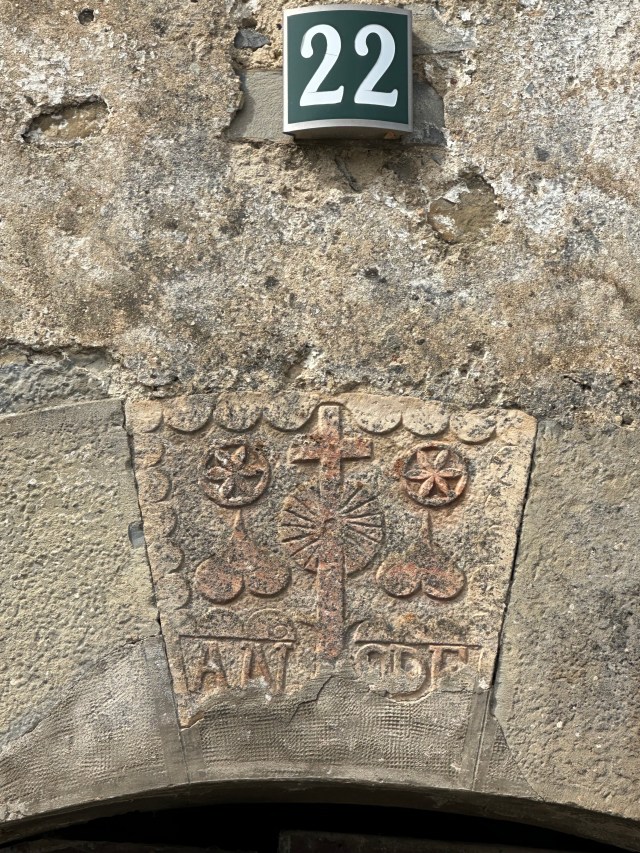
As we Camino’d along, every town we passed through had a Basque Pelota court, which resembled a large version of a New York-style handball court. And this curious form of the cross was common, and usually over a door.

The ‘drops’ on the ends of the cross’s arms are an early form of the now official icon of the Basque people, the ‘Lauburu’, as pictured below.

Many Traditional Basque homes have a decorated or inscribed lintel stone over their door, often employing Lauburu of various styles and forms. These are called Alataburu, and they are wonderful pockets of art and creativity as you walk the winding streets of some of the oldest villages in Europe. Here is where I began to fall in love with the doors of Spain. Here’s a few…




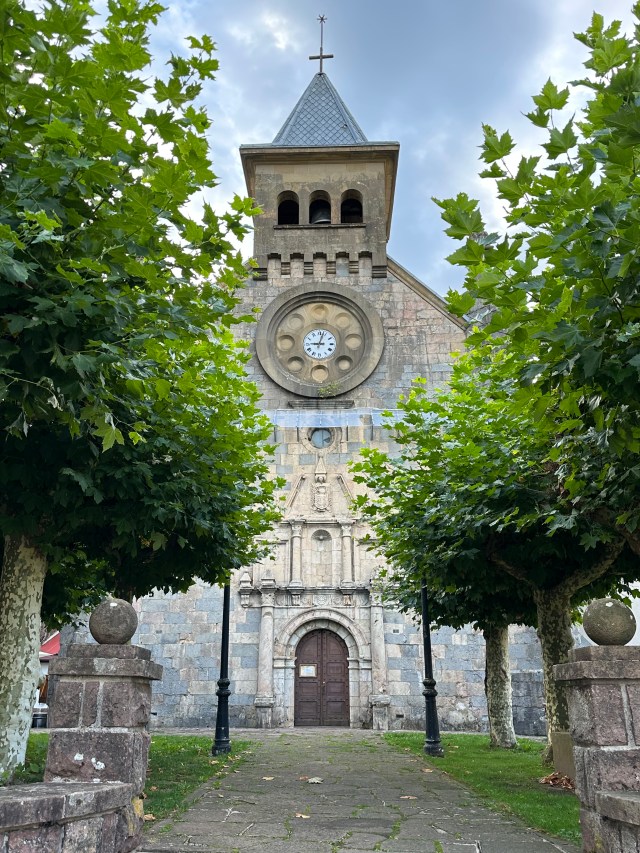
That evening we checked into Posada El Camino albergue in the town of Lintzoain, and discovered the other side of the albergue experience. This was not a corporate hotel, we were in a person’s home. We were greeted at the door ( remove your shoes and poles!) by a lovely couple who welcomed us graciously and even found a way for us to save a couple euros by combining laundry with another guest.
That evening we joined two other guests from South Korea and Czechoslavakia for a home cooked meal that washed away all the memories of corporate food and flat cider. During our stay, Stacy’s amazing Spanish came into play as she was a huge help to one of our fellow pilgrims. As a reward, we were served some Anise home brew liquor called Patxaran, and we melted into that warm place of peace and humanity that only comes from the feeling of strangers becoming friends.
That night, the thunder came. And there were no claps, or bangs or sudden cracks. The thunder of the Basque was a constant roll, that never ceased or paused. I had never heard such a thing, this constant and unremitting roiling roar, loud and unashamed. The thunderstorms of my youth back in Texas came and went like a tornado, fast and terrible but gone in minutes. In Lintzoain the thunder kept rolling, and rolling and then speaking. I could see the Basque in the sound of their thunder, a constant defiant uniqueness: not born of whimsy or reactionary pride, but of this place, these mountains and valleys, where thunder comes and does not leave. After a while, even the terrible roll of the thunder became a friend by it’s familiarity, and I slept unafraid.
My dreams were wild and active. Yours will be too.
Buen Camino.

 buddha meets jesus