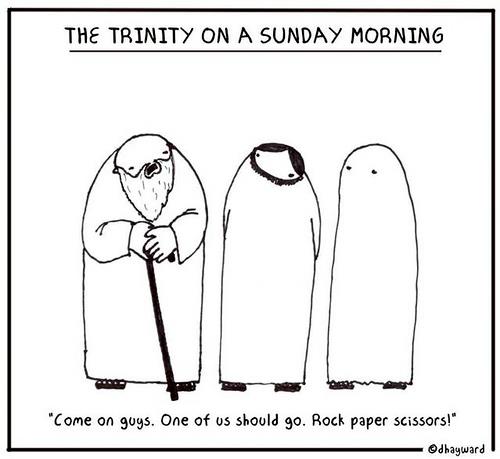
The Trinity as a way to avoid idolatry?–a response…

I’m writing this after reading “The Trinity as a Way to Idolatry” by Rev Alan. Her description of the Trinity as a paradox, and how that was a good thing, hit me wonderfully hard. The use of symbols and statues in Buddhism is controversial if not paradoxical, not to mention all the various Buddhas that dance in and out of the different branches of my faith. The trinity? Pssht. We got a million Buddhas by one accounting….

But we ain’t got no God.

This was my first detour. But I was still buzzing about the concept. What was the closest comparison to the paradox of the Trinity? I had to be careful…not confusing, but a direct paradox. There’s lots of confusing stuff in Buddhism, but where does the Dharma use a direct paradox as a teaching element?

I think my teachers might say a paradox indicates dualism, and all forms of dualism are Verbotten!!! in a big way, a complete way, a total way within the Dharma. There’s a couple passages where the Buddha just won’t shut the hell up about it.

But this passage from Rev Alan’s post took me to a better place of understanding about what i was looking for:

“This is the God who refuses to be boxed up or boxed in, the God is not even limited by the categories we have assigned to God. The infinite God who would learn finitude, the omnipotent God who seems to prefer to manifest itself in human frailty, the omnipresent God who chose life in a single time and place to redeem all of humanity.”

So maybe we should relax about the Trinity. As long as we allow this three-way paradox, perhaps we’ll allow God to be God?”

It’s not about paradoxes, it’s about dealing with the infinite! The unknown, the unseen and all that stuff that happens when you die. And as it so happens The Buddha was asked point blank about these questions of Infinity, and he refused to answer: here are the questions he was asked by a venerable scholar:

(1) Is the universe eternal?

(2) Is the universe not eternal?

(3) Is the universe finite?

(4) Is the universe infinite?

(5) Are the soul and the body the same?

(6) Are the soul and the body not the same?

(7) Will the enlightened one (Buddha) be reborn after death?

(8) Will the enlightened one not be reborn after death?

(9) Will the enlightened one both be reborn and not be reborn after death?

(10) Will the enlightened one neither be reborn nor not be reborn after death?

Here’s what Buddha answered (It helps if you picture him pausing, and then giving out a huge sigh before speaking):

“Remember what I have declared as declared. Remember what I have not declared as what I have not declared. What I have not declared are these ten questions. The answers to these ten questions I have not declared. What I have declared: ‘This is suffering’, I have declared; ‘This is the cause of suffering’, I have declared; ‘This is the cessation of suffering’, I have declared; and ‘This is the path leading to the cessation of suffering’, I have declared. I have declared the Four Noble Truths. Why did I make these Four Noble Truths known and declared? This is because they are beneficial, leading to the cessation of suffering and enlightenment, and they lead to perfect peace, happiness and Nibbāna. Why did I not declare these ten questions? It is because they do not lead to enlightenment, peace and awakening.”

This answer, this refusal to answer, effectively slams the door shut on infinity. Note the careful precision and exactitude of the answer as well; there is no wiggle room, no loopholes, no tricks, no koans, no parables….he flat out says get your head out of the clouds and study the stuff I told you to study! Infinity is for the infinite, you are not.

But as Rev Alan and her teachers describe the Trinity I see it as a different way of dealing with the infinite. The Paradox of the Trinity gives a person a handle, if not total understanding, on those huge issues as reflected in the 10 questions above. The altered tactics..if that is not too martial a term…comes from the importance of the Christian soul, which is to be saved for God, and the Buddhist concept of self, which is to be destroyed.

As a Buddhist learns the lessons designed to teach the delusion of self, he finds himself running over and over again to the escape hatch of the imagination, which is infinite. The ten denials, and other teachings, close these avenues and return one to the source of our problems, the existence of a separate concept of self.

The Christian isn’t asked to do any of that. Instead they are given tools to deal with their selves, their personas, their uniqueness. The seeming paradox of the Trinity uses infinity to connect the individual with the whole, because the one thing that we all understand, that there is some shit we will never understand.

But everything can be understood.

And that is where we come together. Both the Buddhist and the Christian believe that there is something to seek, to find out, to discover, to understand…and this is the best part– we CAN understand these impossible, invisible, confusing three-faced things. It’s hard. It can hurt. And sometimes you have to wear weird hats, but we can do it! And as we do, dealing with the illusions and reality of Infinity is crucial for anyone on a spiritual path.

There is a fine line between infinity and us. Let’s dance on it.

Posted in Uncategorized | Tagged , , , , | Leave a comment

“Caminante, No Hay Camino….”

Part the First, where John learns to take Episcopalians seriously.

I am going to out myself with this blog, and tell you something about my wife that I have not told her.

She had been talking about walking the Camino de Santiago for years. It’s a 800 or so kilometer long pilgrimage trail that starts in the Pyrenees mountains and ends near the Atlantic coast of Spain. And yeah, you read that right, you walk it. The whole way, carrying all your stuff with you. Which also means you are staying in a different place every night, and each place you stay is of student hostel quality . . .you hope.

A line drawing with the Buddha on the left and a woman with her head covered with a scarf. In block letters around the outside reads, "Caminante no hay camino. Se hace camino al andar."

Now, my wife has faced down church boards, Chicago blizzards, accusations of heresy from grad students, mansplaining of cosmic proportions and two of the most teen-agery teenagers that have ever slammed a bedroom door.

But walking eight hundred kilometers? Or so? Under the Spanish sun?

My wife hates stairs, will cross the street to avoid two minutes of Illinois sun, resents her body’s need to sweat and loves to sit in dark rooms for long periods of time reading books and then resting in her comfortable bed. The sum total of all that, is the exact opposite of everything the Camino de Santiago pilgrimage trail is about.

So, I admit, I didn’t think it would happen. When she brought it up for the first time to me, I didn’t actually believe she would follow through with it.  We talk about a lot of stuff, she and I, and we understand that both of us need to talk out loud about possibilities, to see if the ideas will survive the exposure to reality, as most ideas do not.  Hers did.  In fact the damn thing survived and flourished.  But even as she started making plans to clear her schedule, I assumed she would put it aside and go to St Brigid’s cathedral in Ireland, or Cuba, or even Kalamazoo…

But walking eight hundred kilometers?

So then she got the tickets, which sent me into a two day long personal soliliquization about myself, my world, my religion, my faith, my sex life and a particular phrase my wife said to me during an argument not too long ago. “Do you want to be right, or do you want to be in a relationship?”

My rational mind was genuinely concerned about her ability to make such an arduous journey due to certain health concerns she has had over the years, concerns that would be exacerbated by a daily hiking schedule.

My beer-and-a-bump mind was saying, “What the Smurfy smurf is she thinking!?? She hates the heat! Her feet get all weird when she walks too much! Trump’s an asshole (that’s always there in beer-and-a-bump-mind)! And it’s all Catholic and stuff, and she’s not even Catholic! She’s gonna be oppressed by some jerk, and I’ll have to punch out some old Spanish priest and then fight off a whole Convent full of killer Nuns who chase us into Portugal!”

But try explaining that to a spouse.

And there were two other things.

The first was….to my shock…..I didn’t want to go.

My concerns for my wife aside….I didn’t want to go on a pilgrimage. I didn’t want to go on a long hike.  I didn’t want to go to Spain.  I didn’t want to go anywhere.  I had been to a lot of anywhere’s already and I had seen and tasted and smelt the world enough to know the difference between exotic and racist, familiar and foreign, and ‘cultural difference’ and ‘asshole’.  And I now lived in Chicago, a place where you’re always a train ride away from places where you never hear a word of English.  I don’t need to leave home to feel foreign, I’m an American, dammit!  And American foreigners are better than foreign foreigners any day of the week!  

I don’t mean that. Of course foreign foreigners are more foreign, and genuinely more so than American foreigners.  I was in a state of shock, which is often the birthplace of the ridiculous and sublime.  And my shock was born of the completely unexpected opinion and the connected confusion I felt about not wanting to go on a six week 800k hike through Northern Spain following the traditional pilgrim’s path to the resting place of the bones of St. James, an Apostle of Jesus Christ at Santiago de Compestella, in Spain.  I loved to travel.  I loved to see new things. I’ve always been smugly proud of saying my favorite food is something I’ve never had before.  Bring it on new stuff!!!  Huzzah for the shiny and unseen!   

But, to my surprise, no longer. And there was no way in hell I could tell her that.

And, the last thing ( of course there’s three )….

A Buddhist atheist who is studying how not to give into exotic feelings and to be content in the NOW, is about to travel for two months on a Catholic pilgrimage trail through formerly Fascist Spain with a companion who’s Hiking style makes him insane.

The view from the Lakeshore Trail, our Practice Camino

I hate walking slowly for long periods of time. And I never knew that about myself until…when? Can you guess? Yup! Until my wife and I started training for the Camino de Santiago pilgrimage.   Which was a horrible thing to feel, because I love walking hand in hand with my wife. She’s the perfect height for my hand, and strolling down any street in the world with her is one of my favorite things to do in this world. But as we started walking the Lake Shore trail to train, we discovered than when one is a hiking with 20 pounds of stuff on your back, it slows you down a bit, and ain’t nobody holding anybody’s hand. And as for Stacy, it slowed her down a lot. As for me, oh my faithful reader, I was in the Boy Scouts, raised in a place where walking five miles a day under a South Texas sun is how you get to the swimming hole, I use our elliptical regularly and I actually like to sweat. I like to walk. I choose the stairs over elevator every time. I like to hike, and I like to hike fast. Not slow. I want to go! Huzzah! My wife was not going to be a Huzzah! kind of hiker. She was slow, and for me, very slow. Now, I do have to tell you that as we trained she did get stronger, and she got wiser, she also got swollen, but then she got solutions for the swollen and kept on training. Watching her fight through the pain and increased ankle mass should have made me proud of her. But I wasn’t. I was terrified. Because she was going to go through with this. We were going to go through this. I was going to go through with this.

It was everything I didn’t want to do.

Which means, it was exactly what I needed to do.

By going to foreign places aware of how they can intoxicate, I will practice not being intoxicated. By sharing space with cultures and religion I have found disagreeable, I will practice Mindfulness and seek to understand that which I once thought I should hate. By doing something I do well with another who doesn’t, I will learn how strength is nothing when not shared.

Doesn’t that sound so enlightened and grown up and Buddha and smart and wise and shit? That’s because I just wrote it, right now. There’s a fine line between enlightened and multiple rewrites. My wife would call the above a reframing, which is a word I mistrust, as I have seen Reframing used as a framework for falsehood. And it’s important to know that Buddhism isn’t a reframing, even in the positive sense of seeing something from a different perspective. It’s more of a re-sculpting, where we chip way at all delusions and all perspectives, not refusing to see other perspectives, but ridding ourselves of the concept of Other.

But I wasn’t quite there back in Sept of 2023, when we started the Camino. But we had new shoes, new backpacks, bags of lambs wool for some reason, hiking poles and two tickets to Madrid, Spain. If nothing else, we would get to have some of that wonderful Spanish cuisine!

Buddha and Brigid were about to go on a walk.

MORE TO COME AS BRIGID AND BUDDHA WALK THE CAMINO-“NO HAY CAMINO…” PT 2!! THE SPANIARDS HAVE NO SALT!!!


Posted in Uncategorized | Tagged , , | 1 Comment

Everyone’s Looking at Me, until there is no Me.

Stop sign reflection in New Orleans street puddle. Photo by Author

We are having our kitchen remodeled. That is such an innocent looking sentence, isn’t it? And deceptively vague. It could mean that we’re putting a new coat of paint on the walls and buying a new set of Corningware. What is actually happening is all the walls and floors are being ripped out down to the dirt and studs, all the electrical wiring is being replaced, and all the plumbing is being…….re-plumbed, I guess. While all the ripping, rewiring and replumbing is happening we are still living in the house, with nary but a makeshift wall of industrial black plastic between us and a platoon of contractors and their nefarious devices….

None of which are worse than leafblowers.

One of the results of this is that when I am ellipticating….on my elliptical…the guys working on the new kitchen are just six feet away with only a garbage bag wall between us. Usually, no big whoop. But yesterday my earbuds were broken, and you gotta have music, so I played my exercise list out loud on the speaker without realizing I would also be playing it for the six guys currently sheet-walling a mere garbage bag away. That is until the Go-Go’s came on and the work suddenly got all quiet over there….

Oh shit. My stomach panged with anxiety as a thousand moment of hell from High School and beyond flung themselves at my psyche’s walls. But 15,000 hours of improv loomed in the wings, crafting responses, thinking of snappy comebacks, which in the end only makes it worse! I became a creature of pure reaction. All sense of personal identity were gone. Because other people are paying attention to me….

Song by song, my attention flies from my ellipticating to the unseen men behind the screen. I can feel my thoughts reconstructing the unseen scene in my head. The smirks, the raised eyebrows, the silent mocking gestures…and then my Dharma Barrage Balloons floated up from the battleship SS Mindfullness. Barrage balloons were used in WW I and II to protect ships from incoming shells. They were unmanned and tethered to prominent targets, floating far above, shielding all below. The first Balloon: who cares if they think I’m dumb, weird or goofy…I am. I’ve been paid to be dumb, weird and goofy, and paid well. Second Balloon: if they do hate me, I can take it. Being hated and mocked just for a guy’s music? That’s not a person I need to take seriously. Third Balloon: hating other people takes time and effort, and these guys are working for a living, they don’t have time for high school level bullshit. Fourth, who is this that’s getting worried? And changing his playlist? And thinking about what other people are thinking…..oh yeah. The self, that thing Buddha teaches doesn’t exist….Poof.

Can you imagine the huge ego of this self? It thinks the whole world revolves around it! That all things are reacting to only to it. It even believes the unseen and the unknown pay it homage, when the exact opposite is the truth. The Self is nothing but a series of reactions to the world, and it’s a never ending series of reactions to the world, I might add, which means this self is actually always in a state of flux, which then means it will always want something else and usually it will want something different that it claimed to want just a little while ago! That’s what a schmuck does! The Self is a total schmuck!

Until I began to meditate and study the dharma, I had no idea any of this was going on in my head. I knew something was up, as I was miserable, living a shitty life and my dawn was always lit by the burning bridges from the night before. Despite this inspiration, my conversion to teachings of the Buddha and his teachers, collectively referred to as the Dharma, was more of a gradual surrender rather than a life changing bolt from from the blue. Bit by bit, the dharma proved itself to me. I am still climbing out of the deep, deep ruts that this thing people call John and the World dug for itself. And I’m getting there, and I’ve worked my ass off to get there, but despite All the There I’ve Gotten Too, I can still instantly turn into a seventeen-year-old from the fear that strangers won’t like my playlist.

It’s a looping cycle of self awareness, based on nothing but guesswork, suspicion, self loathing and the need to blame something else for all my problems. I’ve gotten angry from imaginary arguments I’ve had with strangers I’ve passed in the street. How the hell does that happen? And the argument is never a Socrates style discussion where I learn about myself and the world from a cogent question and answer session. Nope. It’s like a bad Dragnet episode where I’m Jack Webb and I’m right about everything and the perp gives me all the perfect prompts for all the best points of my never ending lecture. Sometimes we get into a fight I miraculously win using combat techniques that I have never learned or attempted. Unirregardless of the genre of this imaginary conflict, I still get physically angry…. at an illusion about an illusion.

When it comes to how much this concept has wrapped itself around my life in negative and positive ways, the Gordian Knot is a weak-ass lame poser. It has taken some time to deconstruct, but it begins with a Bi-polar Manic Depressive mother and ends with an adventurous evening at a sex club.

I lived to make my Mother laugh, or to be at least not sad. I had to do this a lot. As a result, I subsumed my own wishes and desires under a persona that was agreeable and happy. I said things I did not believe, and did things I did not want to do, and rarely considered my own feelings in the matter. My only peace were books or TV, which I would enjoy by myself. Alone. I would pretend to be anything to get to the place where I could bliss out with blessed fiction and Histories of the grand and great. Alone.

Outside the land of counterpane, the only other place I ever felt safe was the stage, where I could continue to not be myself and win the approval of others. And so night after night, my psychosis was rewarded with applause. And sometimes they even gave me money! With every opening night, the scars got thicker, but there wasn’t any healing going on. The thing is, when you are pretending to be someone you’re not on stage, it’s easy. Off stage, it’s impossible, because it’s literally making you crazy. I would go along for a while seeming just fine and then fail, freak out and act out in irresponsible ways. Everything I did was in service of pleasing the person in front of me, in the moment, which meant I wound up lying a lot. I would be wonderful in my job at times, and then catastrophically incompetent the next. So, in the long run, my trauma transformed itself into the behavior of a Bi-Polar manic depressive. Hi Mom!

I ain’t telling you about the sex club.

In Buddhist terms, the experiences with my mother were conditional volitions, repeated activities that get worn into a grooves in my brain. Cool term, eh? Buddha spends a lot more time with this term than I’m going to. After all, We’re here to talk about me…or the lack thereof.

Admittedly, it took three weeks of hiking in Northern Spain to begin to understand what the Dharma teaches about the self. It will take a lot longer to apply that understanding to my life.

Do you feel eyes on you, even when they’re not? How do you handle it? How do other people’s needs alter your own? And who’s needs are more important?

‘cuz it would be nice to play music everyone likes, even beyond the garbage bag walls. But you can’t please everyone, so you got to please yourself, says Ricky Nelson and The Buddha. Both are on my playlist.

Posted in Uncategorized | Tagged , , , , , , , | Leave a comment

The Trinity as a way to avoid idolatry?

A long time ago I heard a theology professor say, “You can’t talk about the Trinity without committing heresy. You just have to decide what is not negotiable and what heresy you can live with.” In her case, the Incarnation was not negotiable, so any Trinitarian statement that compromised God’s taking on human flesh was not to be tolerated.

Shortly before Trinity Sunday, you’ll hear the preachers whine and tear out their hair (not sure what that sounds like) trying to remain within some kind of orthodox boundaries while not putting their congregations to sleep.

I’ve not had that issue with preaching on Trinity Sunday. For one, my Trinitarian theology was profoundly shaped by Robert Farrar Capon’s delightful fantasy describing the Trinity’s calling forth of creation as an epic dinner party with bad jokes and crazy fish swimming in the glasses of wine. (See The Third Peacock, chapter 1, “Let Me Tell You Why.” You can read the excerpt here.)

What I learned from Capon is that the Trinity is a party. Now much smarter and more erudite theologians will have more nuanced and complete ways of elucidating this (often using that very sexy word, “perichoresis,” which literally means “rotation” and actually makes the Trinity not just a party, but a dance party!).

The upshot is that the Trinity is hard to grasp, both in terms of brute understanding and of overall comprehension: Three in One and One in Three? One God yet Three Persons? (Persons being not a simple cognate of the Latin persona.) Coequal, coeternal, consubstantial? In my former parish we used to recite the Athanasian Creed on Trinity Sunday—which includes this bit: “As also there are not three incomprehensibles, nor three uncreated: but one uncreated, and one incomprehensible,” to which one Trinity Sunday I quipped, “The whole d*mn thing incomprehensible.” It always struck me as defensive, defining God as what the Trinity is not, rather than what God is.

The Christian tradition from very early on—as early as Paul’s letters and the Gospels—had rudimentary Trinitarian formulations. As the theology of the Trinity developed over the centuries, there was this strange insistence on contradictory and paradoxical assertions1: three yet one, united in deity and action, yet distinguished by name and relationship to each other. We seemed, as our Jewish and Muslim cousins often point out, intent on making it stupid hard not to look like polytheists!

Years ago, when I was making the Ignatian Spiritual Exercises, I had an experience in prayer of someone I thought was Jesus. He seemed a little judgier than usual, kind of sharp, which can happen, but something didn’t feel right. So I extrapolated that Jesus onto the Trinity: what would the Trinity be like if Jesus as I was experiencing Him now were the 2nd Person, i.e. the Son? When I did that it felt all wrong and it became clear that the Enemy2 was trying to distract me from the work God had in mind for me that day, prayer-wise.

So why this strange insistence on making the Trinity so difficult to grasp?

Judaism has, since day one, has taken a strong stand against idolatry, which essentially means allowing anything or anyone to take God’s place. Christianity inherited that insistence.3

So it has occurred to me that perhaps the Christian tangle of contradictions (we like to call them paradoxes or mysteries, but tomato, tomahto) that we have built up around the Trinity is a way of preventing a kind of idolatry: if you can’t pin down God as Trinity, then, well, you can’t pin down God!

I’ve found that when I pray with the Trinity (versus praying with the Father, the Son, or the Spirit), my experience of God is more expansive, a little darker (i.e. more mysterious), more dynamic, a bit like a stationary whirlwind. (Some of you may associate a more dynamic experience of God with the Holy Spirit, which I find to be the case, too. The Trinity feels more three dimensional, which as the Spirit is more two dimensional wind-like?)

Perhaps we should pray to and with the Trinity more often. This is God as ultimate, yet loving mystery. This is God way beyond gender. This is God who is, dare I say, syncopated, but something more complicated than a two-against-three rhythm (or this amazing 4-against-7 polyrhythm or this one, which I can’t break down at all).

This is the God who refuses to be boxed up or boxed in, the God is not even limited by the categories we have assigned to God. The infinite God who would learn finitude, the omnipotent God who seems to prefer to manifest itself in human frailty, the omnipresent God who chose life in a single time and place to redeem all of humanity.

So maybe we should relax about the Trinity. As long as we allow this three-way paradox, perhaps we’ll allow God to be God?

Hee hee.
  1. Along with its sibling paradox, the dual nature of Christ, i.e. Christ is fully human and fully divine, completely and inseparably, yet without losing the qualities of either one. ↩︎
  2. A brilliant bit of vocabulary, which can mean Satan, an evil spirit, my neuroses, or the effects of a bad day, depending on your theology and what’s most useful in getting yourself back on track. ↩︎
  3. Pace my Hindu and Pagan and other polytheistic friends. I have no issue with multiple gods, nor with images made of them per se if that’s your religious jam. But among the monotheists, all three of the big ones—Judaism, Christianity, and Islam—are pretty insistent on there being just one God and that our loyalties are not to be divided, and the Jews and Muslims particiularly clear—clearer, frankly, than the Christians are in practice—on not making images of the divine. ↩︎
Posted in Stacy | Tagged , , | Leave a comment

Lou Reed’s Anti-Bodhshattva.

(SUNRISE AT PROMONTORY POINT, CHICAGO. PHOTO BY AUTHOR)

There is a certain kind of perfect morning that I never thought I would experience: The Big City Perfect Morning. That perfect morning you see at the beginning of Rom Coms set in New York or Chicago. Picture it: The lead character walks to work and stops at least twice to buy food from people who smile back at him. His sun dappled, tree-lined walk is filled with interesting sights and people living good lives until he arrives at work happy and content ready for the plot devices that await him. Now, I was raised in South Texas, where cool mornings don’t happen, trees are short, the sun is an enemy, and the humidity puts all people into a constant state of shvitzing. We’re damp. Always. We don’t even bring it up. Also we don’t walk anywhere, that’s how the sun kills you.

But, it happened. After twelve years in Chicago, I had a Perfect City morning! About an hour after dawn, I stepped outside into that cool sun dappled air…and I’m not exaggerating, that sun was dappling all over the goddamned place! I thought Thomas Kinkade must be hiding around here somewhere. I walked to a local bakery, that smelled like fresh bread, where I got a demi-bagette and a coffee. The line went fast, and everyone smiled and interacted at me just enough without wasting my time with bullshit chat chit; the perfect consumer transaction! Two blocks down I stopped and got a bit of cheese from a mom and pop convenience store, were I also found clean surfaces and smiling faces…do you know the rarity of a convenience store with clean surfaces and smiling faces? Thusly ensconced with bread, cheese and coffee, and a renewed hope for Humanity, I walked to Promontory Point past my neighbors’ sidewalk gardens profulgent…Yes! I DO dare to use that lusty word! Profulgent with colors from all kinds of roses, tiger lilies, daisies, hydrangeas, red columbines, cornflowers…

By this time in Texas, most things are brown. In a month, they’ll be crispy.

But not today! And not in Hyde Park!

The Hyde Park neighborhood of Chicago is the most parkiest of all the parky neighborhoods in Chicago. We have Washington Park, Roosevelt Park, the Midway Plaisance, The Lakeshore Trail, the grounds of The Museum of Science and Industry, Jackson Park and eleven smaller parks and playgrounds scattered through the area…and the local favorite, Promontory Point; a field surrounded by trees that juts out into Lake Michigan whose shoreline is an intoxicatingly chaotic tumble down pile of boulders and rubble. The northern view of the Chicago skyline is inspiring, the southern view of the Gary industrial sprawl is prophetic.

When I made it to Promontory point, I was chromatically not alone. There were bikers, walkers, joggers, runners, swimmers and divers, fire rings were being prepared for cook-outs to come, and there was a huge 60 person yoga class on the farthest tip of the point, making themselves stronger and happier by the backdrop of the shimmering waters of Lake Michigan. I found a bench and started to eat my breakfast of fresh bread and cheese, a meal I had grown to love when my wife and I had hiked the Camino Santiago in Spain, and every bite was a communion of sense and memory. I was surrounded by people being happy, doing things good for themselves, and not getting in each other’s way while they did it-and I was one of them! It was just like in the movies!

A perfect Big City Morning.

Then…the leafblowers.

That grinding, high pitched droning blast that comes from The Devil’s own ass blasted across the swimmers, the runners, the guys starting fires at the pits and the 60 person yoga class. Instantly, everyone had to stop what they were doing to compensate for the noise that had vomited all over them. Voices got louder, speakers were turned up and people moved away. From my vantage point, at least 32 smiles instantly left their faces.

I needed to see it. I had to look at the person who was leafblowing. I needed to stare at them, and I needed to see them doing even more stupid, useless, annoying things. And yes! My angry suspicion was confirmed to see the leafblower spewing forth air…and nothing else! There were no leaves on the ground they were blowing. A few stray sprigs of grass were sent careening, and I’m sure a lot of bugs were pissed off by the passing of Satan’s Blowhole, but there sure as hell wasn’t any leaves being blown. Of course! I knew it! So I had even more reason to hate everything about that thrice damned, smelly, putrid, awful, Putin loving, MAGA inspired, taking-candy-from-babies, puppy kicking and kitten punching machine and the person who operated it!!!

I turned around, ready to get mad…and I stopped. I paused. The thoughts that were forming in my head ceased their hot march to my mouth and heart….and I looked back.

The person leafblowing was wearing the yellow uniform of a city worker. So, someone didn’t just show up and start shitting on my perfect day for fun. She was getting paid, someone told her to come here. And THAT’s that’s the guy I can hate! The supervisor! Who the hell tells someone to clean up a park on a Saturday morning—the busiest time for a park, for any park?? Oh, wait, but over by the lighthouse there’s a van with guys tumbling out if it setting up an awnings and flowers…. Ah. It’s a special occasion, the park’s lighthouse building is going to be used for a wedding, so the crew is cleaning up for the event. Well, shit! Now who do I get mad at? How about the Corporate wedding industry that forces people to spend thousands of dollars on lavish ceremonies that mean nothing to them personally and then ruins the mornings for nice people like me, the swimmers, the runners, the firestarters and the 60 person yoga class!

By then, I was starting to get tired from the effort of looking for someone to blame.

I have spent a lot of time looking for someone to blame for leafblowers. They have become in many ways my anti-bodhishattva; a living symbol of all the things that keep me disturbed, upset and un- helpful to the world. The early morning leafblower that is blowing nothing, or very little, is an actual act I have witnessed many times from my window, and it is a stunningly perfect analogy for everything that is wrong with society and ourselves. I have thrown thoughts, prayers, wishes, scenarios, schemes, threats, cunning plans and devious enterprises at this problem. Now, because it is small, you might say why bother? “Because it is small, I should be able to solve it!!” Is the cry of my inner Manly Man! It’s wrong! It’s dumb! It’s useless! Those guys are even hurting themselves by using them! I’ve researched the subject thoroughly-and not just Wikipedia, in actual books!! I should go down there and explain it to them, carefully but passionately!!!

…Is the first idea that won’t work….

After going through a Wile E. Coyote-worthy series of possibilities in my head, the one thing that became absolutely clear was that yelling at anyone or anything would not help at all, even if you are really good at it, mean well, and look like Tom Cruise.

Damn. Buddha was right again. Don’t you kinda hate people who are always right? Especially about hating other people?

But I am still conflicted, because Donald Trump exists, as do his followers. Trump is what happens when small annoyances are allowed to thrive; they are pearls of destruction, made large by indifference. But the Dharma does not teach indifference, or passivity when it comes to unwise people doing unwise things. It teaches understanding through mindfulness, and by this understanding we will find a solution to our problems within ourselves, which will create solutions without ourselves.

But that shit’s really hard to do, man! And it takes time! So while I’m sittin’ on my cushion, trying to get myself to right side of the Dharma, my government might be burning my house down around me! That ain’t what Buddha wants. But he also doesn’t me me running around and yelling like a, well, like a leafblower.

It’s really hard not to to become a leafblower when you hear one. But I also don’t want to be a leaf.

Then Buddha smiles and says, “Why do you WANT, at all?”

…..asshole.

Posted in Uncategorized | Tagged , , , , | Leave a comment

Buddha and St. Brigid take a walk

This is us, sitting on our couch, just a few hours before we leave for the airport, where we will fly to Madrid, and then will walk the Camino de Santiago!

Posted in Stacy and John | Tagged , , | Leave a comment

The Dating of James

I found this amazing piece years ago but the original post seems to be gone. So, in order that it not be lost to the ages, I share it here.

The Dating of James   

by David Hackett

Scholars hold a variety of opinions on the dating of James.  He is most often believed to be the brother of our Lord. If so, it is most likely that he is the younger brother of Jesus, because if we were to hold that he was the older brother of Jesus, this would have obvious ramifications on the doctrine of the virgin birth. Having such an older sibling as a role model is a strong benefit in the dating of James, since Jesus would have taught James everything he knew about dating.

Since his writings reveal a caring, observant, peace loving, and deeply spiritual man, most authorities believe that James would have been an appealing date for any number of women in his region of the Eastern Mediterranean seeking these qualities. But given his spirituality and cultural context, it is more likely that he dated only occasionally, and then probably only with Jewish women from his local area.

Probably the most attractive aspects of James that might influence his dating habits are that he refers to himself as a servant, that he demonstrates endurance in relationships, and that he speaks of giving generously and ungrudgingly. He prefers actions to mere statements and so it can be assumed he would creatively express devotion to his dates in concrete and practical ways. He acknowledges that he makes mistakes (“All of us make many mistakes,” James 3.2). He advocates being slow to anger. All of these factors show a familiarity with human relationships more commonly found in those with a well-developed dating capacity.

James writes, “blessed is anyone who endures temptation.” (James 1:12) This is perhaps the most overt reference to and personally revealing insight into James’ dating.  He says, “one is tempted by one’s own desire, being lured and enticed by it.” This is evidence of his active and inner-conflicted dating life. Additionally, James often refers to others in terms that invite intimacy, such as his frequent use of the term, “my beloved.” Perhaps men of our day will discover in James a man cut from their same cloth, and find new affinity for biblical personages through a review of the dating of James.

Other scholars of course note the use in chapter 2 and other chapters of the phrase, “my brothers and sisters.” Such continual phraseology does not lend credibility to a theory of a dating James. He seems to disparage gold rings and fine clothes, which is a persuasive argument that perhaps James does not understand and relate well to women after all.

On the contrary, however, the extensive discussion in his writings about arguments among friends, about conflicts and disputes, and about communication difficulties (for instance he mentions “you do not have, because you do not ask”) all are all the more reason to conclude that James maintained a series of friendships and in fact, relationships with women and therefore most certainly an active dating life. He perhaps pioneered a theory that men are from Mars and women are from Venus.

Given all of this data, we can confidently assume that James, over his active lifetime, probably completed somewhere in the neighborhood of 400 dates. Schultz argues for a larger number, nearer to 550 [Schultz, Modern Dating in James, page 250), while Steinsteffler offers  a more conservative figure, 250 (Steinsteffler, The Proclivities of James, page 65).

David Hackett, hackett@pff.net, http://www.pff.net (This link redirects to a different site, but it is where I originally found it years ago.)

Posted in Stacy | Tagged | Leave a comment

Taking vacation, or going on vacation?

I struggle with vacations. Not in the way you often hear people talk about it, not in the “I have too much work to do,” “I’m indispensable,” over-functioning kind of way*

Whenever I tell people about a vacation—does one “take” or “go on” vacation? Those seem like very different things—they always ask where I’m going. I travel a fair amount for work and my husband and I do love to travel, but by the time I’m looking at taking vacation time during the summer I don’t want to go anywhere. I don’t want to plan anything. I don’t want to herd any cats, since THAT’S WHAT I DO THE REST OF THE YEAR! I find myself longing just to stay at home.

I also end up seeing this time as some kind of epic reset button for the chaos in my home. I’m not a very organized person and there are always backed up, overdue, leftover projects that need doing. Where did I put our tax papers? We should really repair that broken chair, which requires going through the stuff that’s piled on top of it, which inevitably means finding some papers that need filing, photos to be dealt with, a sweater that should probably be returned to the friend who left it here six months ago, a souvenir from a trip three years ago . . .

Yet I feel pressure to “go on” vacation. We were invited to spend a weekend with friends in Michigan and I began to plan an epic roadtrip that involved a drive all the way around the lake, seeing a friend and colleague in the UP, visiting a family homestead in Northern Michigan, going to Mackinac Island. My husband pushed back, and I realized that I didn’t really want to go on an epic road trip. I want to stay home (except for that weekend with friends). I want to make home a place that refreshes me. Then I might have the energy and wherewithal to plan that epic road trip. Maybe next year.

*Although this year has had whiffs of that. I won’t really have a chance to check out completely from work this year: I live where I work and there are things that just demand my attention, and my attention alone.

Posted in Stacy | Tagged | Leave a comment

Reading Baptized in Tear Gas and marking the Feast of St. Oscar Romero

I’ve been reading Elle Dowd’s powerful book, Baptized in Tear Gas: From White Moderate to Abolitionist, in preparation for her visit to my campus ministry in a couple of weeks. In her chapter called “Joy as Resistance” she describes her arrest when she participated in a nonviolent direct action in response to the murder of Michael Brown in Ferguson. It’s chilling stuff. Then I read this sentence: “They had us line up in another hallway, and again, I was with people who I didn’t know. They kept separating us and moving us around, never telling us where we were going.” (p. 116) I started to feel on edge, in that way when a connection is beginning to get made, but doesn’t yet flow. Then, a few paragraphs later:

If I was treated this way, with all of the privilege I possessed, with all eyes on Ferguson watching, how do you think young Black people are treated when no members of the media are present to tell the story? My mountains of privilege surrounded me with a cocoon of safety, and still I was beaten by police in the middle of the day with cameras watching. But Black people fare much worse at the hands of the police. They are threatened. They are terrorized. They are beaten. They are imprisoned. They are disappeared—or worse.

Baptized in Tear Gas, p. 117, emphasis is the author’s

I don’t know what sounds these kinds of connections make: Pop? Click? Whoosh? Oh, f*ck? Whatever that is, I heard it. Elle’s description of being disoriented and isolated after her arrest, the fear that no one would know where she was, of not knowing what would happen next or whether her rights or her person would be respected or violated—all of this reminded me of the myriad stories of those who stood against the dictatorships throughout Latin America. That was where I learned the use of the word “disappeared” as a noun and of “disappear” as a transitive verb with subject and object (as in “Maria was disappeared.”)

Then, in reading the second paragraph, where Elle notes that even her privilege as a white person didn’t protect her, I remembered what day today is. It is the feast day of St. Oscar Romero, the Archbishop of El Salvador, who was killed in the middle of saying Mass on March 24, 1980. It’s a day that my children and I note every year because of the ways in which it connects to our family history. Their father, who is from El Salvador, was at the Archbishop’s funeral in San Salvador when snipers began shooting at the peaceful crowd. He was tortured* by the miltary and eventually had to flee the country, fearing for his life and the safety of his family. I have other friends who had similar experiences, whose ability to live full, healthy lives has been hindered by the violence they witnessed and which was inflicted on them. El Salvador is a nation living with individual and communal trauma in ways that we (white folks, at least) cannot imagine. And El Salvador is only one of a number of countries in Central and South America and the Caribbean with a similar history of violence, injustice, and oppression—often supported by the United States.

So as I read Elle’s words, I realized (later than I should, but I am congenitally naïve) that our country is closer than I would like to believe to the kind of place I witnessed and heard about in the 80’s, a place where peaceful protest could be considered a capital crime, where police are militarized, and a place where the idol of “security”—as defined by the same military and police and others in power—demands sacrifice from those who might disrupt it or question it.

I was listening to an interview with Guillermo and María Hilda González, who were friends of Romero. María Hilda said something that caught my ear. She was describing her thoughts when she heard of Romero’s assassination:  “It can’t be, if the bishop was killed, what’s going to happen to us?” If an Archbishop of the Roman Catholic Church, a representative of arguably one of the most powerful institutions in the world, isn’t safe from out and out murder, what, indeed, will happen to the poor? If four white American missionary women could be disappeared, raped, and killed, what will happen to those who can’t leave? If six Jesuit priests and the women who cared for them can be rounded up and shot in the middle of the night in their own home, will we finally step up and speak?

All of those assassinations happened in the 1980’s in El Salvador, yet the civil war didn’t officially end until New Year’s 1992. And El Salvador is still struggling to heal; the toxic, repeating cycles of violence have just shifted to other actors. Here in the U.S., we have our own martyrs. We try to sanitize them: I have been shocked (again, I shouldn’t have been, remember I am wired to be naïve) by the number of people in my social media feed who argue that Martin Luther King, Jr. would not have approved of the protests after Michael Brown’s killing, or Trayvon Martin, George Floyd, or Tamir Rice, or Breonna Taylor, or that Colin Kaepernick’s kneeling during the National Anthem was inappropriate. We have our own disappeared—Black men lost in the prison system, Indigenous women, trans women of color, immigrants trafficked in domestic service, agriculture, sweatshop and factory work, restaurant and hotel work and in the sex industry.

The one thing I do every year on this day is listen to the recording of Romero’s last radio homily, the sermon that probably sealed his fate. Even if you don’t understand Spanish, the authority of his words is powerful. They bring me to tears, every single time.

One of the questions that has been a theme of my ordained ministry has been that of authority. What is my authority as a priest, exactly? Is it earned or is it conferred—or both? How do I embody it and enact it in ways that promote the Gospel and encourage God’s people? Romero’s voice in his last radio sermon is an example of someone who had, it seems, answered those questions for himself. Listen to this recording. Even if you don’t understand Spanish, you know that he is speaking with God’s own authority:

I would like to make an appeal especially to the men of the army, and concretely to the National Guard, the police, and the troops. Brothers, you are of part of our own people. You are killing your own brother and sister campesinos, and against any order a man may give to kill, God’s law must prevail: «You shall not kill!» (Ex 20:13). No soldier is obliged to obey an order against the law of God. No one has to observe an immoral law. It is time now for you to reclaim your conscience and to obey your conscience rather than the command to sin. The church defends the rights of God, the law of God, and the dignity of the human person and therefore cannot remain silent before such great abominations. We want the government to understand well that the reforms are worth nothing if they are stained with so much blood. In the name of God, then, and in the name of this suffering people, whose laments rise up each day more tumultuously toward heaven, I beg you, I beseech you, I order you in the name of God: stop the repression!

There are questions I must keep asking myself, as I read Elle’s book and remember Romero: Where am I called to stand? What truth am I called to speak and to whom? Where does justice demand that I use my authority as a priest of the Church and my privilege as a white, middle class, educated person to speak out, as Romero did? And more importantly, perhaps, as Elle has been reminding me in her book, whose voices should I be listening to? Whose experiences need to guide my work? What are my blind spots? What is my complicity?

I’m still figuring that out.

And so today, I ask St. Oscar Romero to pray for me, that I may listen as he did, to the cry of the oppressed, and discern, as he did, how to act as the Gospel demands and as Jesus calls.

*And I’ll just say this here, because somehow it still needs to be said: torture is always wrong. It can irreparably change a person’s brain and body, leaving them with permanent scars, seen and unseen, and leaving others to live with the aftereffects. Having lived with a torture survivor, I can tell you that it is tedious, and taxing, and hellish, all at the same time.

Posted in Stacy | Tagged , , | Leave a comment

A Rainbow Connection?

[There is so much that I’m planning to write on—urgent things about God and justice and prayer, about racism and hurricanes and taking sides, and what this all means on a college campus. Those will come. However, this happened to me recently and I needed to get it out of my system first.]

double-rainbows-1200x800

I didn’t take this picture. I found it online. But my rainbows were just this bright.

I believe that God created the universe. I believe in Providence, the idea that God didn’t just set the world in motion, watchmaker-style, but is deeply involved—or at least present—in the workings of the cosmos, caring about the sparrow that falls from the sky, but available to me in my every thought and breath.

Those two things are important to know before I tell you this story.
I was driving from Chicago down to eastern Tennessee, a 9+ hour drive that took me through the mountains of Kentucky. Stretches of the road had been no fun for driving: periods of driving rain, construction, accidents (I passed two serious-looking ones within ½ mile of each other going in the opposite direction). As I went further into the mountains, through towns that could spread only so far to the right and the left, constrained by steep slopes on either side, I was frustrated and wearied by the rain, unable to enjoy the drive as I gripped the steering wheel and looked through the windshield wipers whipping at their fastest speed.
Just before I drove through the tunnel at the Cumberland Gap, I posted as much in a Facebook status. I love road trips. But not in that kind of weather.
After the tunnel, the clouds lightened a bit, with rain spitting occasionally, so I could relax little, but not too much, since the road continued to curve perilously through the hills. As I came around one bend, the entire windshield was filled with the vision of two full double rainbows. They were were not far away on the horizon, beckoning me somewhere beyond, but RIGHT THERE in front of me, one end of each rainbow just a few dozen yards ahead of me on the road.
I yelled. I literally yelled at least three times, alone in my car, as it moved at 60 miles an hour, trying to see the rainbows and stay on the road. It was two full rainbows, not one full and one ghostly one behind. They were brazen. Confident. In my face.
My mind raced: what I should do? A fellow traveller pulled over just ahead of me, clearly planning to step out and take a picture, or at least take it all in. I pondered doing the same, but I knew that, as good as smart phone cameras might be, I’d never capture the magnificence, the scale, the in-your-faceness of this moment. So I kept driving, at each bend ready to let go of the brilliance as the hill obscured it, only to be delighted when it appeared once again. This went on for several miles.

Rainbow Connection Finale

There were no muppets at the end of my rainbows.

I wept—carefully, since I was still driving, downhill now. It felt like a mirror image of the awe I felt at watching the eclipse last month (fully on television, and partially in my yard): then it was awe at the darkness, this was awe at the light. As the vision settled into my consciousness and I tried to fix it into my memory—since there would be no photo—I began to wonder what marvelous experience meant.

This was a question my husband and I had pondered during the eclipse last month. For most of human history eclipses were rare enough and few people traveled far enough to know that they were natural and not portents of disaster. Eclipses were given meaning—cosmic, formidable, dire meaning. We now know that, at some point, the moon will inevitably pass in front of the sun—there is no prophetic message in it. The sun will cede its place to the moon and the world below, for a few minutes, will become something wholly other. It is eerie. It feels mysterious. And it is simply how the world works.
Now as I drove, stunned into silence and delight, I wondered if I should be feeling something somehow “spiritual.” Should I wonder if this is a message from God? Should I feel some kind of explicitly theistic gratitude or awe? Strangely, I didn’t. This didn’t feel personal. I have gotten messages from God before, and this wasn’t it. I could have manufactured gratitude, but, strangely, it didn’t feel necessary. God’s feelings were not going to be hurt if I didn’t stop to compose a psalm at the side of the road. My delight was enough.
It felt like the world doing what it was made to do, in surprising and predictable ways. The sun was shining at just the right angle behind me through the leftovers of the rain, and my car and I, as I drove, continued to return to that just-right angle. Physics and weather and geography all did what they had been made to do. And they did it well.
God didn’t need in that moment for me to stop seeing the water vapor transformed into prisms of light and, or even to use it as some kind of lens toward God. God was in the car with me, driving down the road at 60 miles an hour, sitting the in passenger seat beside me, yelling, just as delighted as I was, at the glory of the rainbows, doing just what they were made to do.
Posted in Stacy | Tagged , | Leave a comment